I keep seeing this drug reviewed the same lazy way: “generally well tolerated,” full stop, next paragraph. I don’t buy that framing, and after going through the actual trials, I don’t think it holds up. So here’s my honest take, reviewed the way I’d review anything else, what it claims to do, what actually happened in the studies, where it earns some credit, and where I’d tell a friend to walk away.
One thing before the ratings start. Anastrozole is a prescription drug. Using it in men on testosterone therapy is off-label. Most men who take it get it compounded, not the branded tablet. Everything below comes from the published trials, not from my own body or yours, and a milligram that does nothing to one man can flatten another.
What it claims
The pitch, as far as I can tell from how men talk about it online, is simple: it blocks the enzyme that turns testosterone into estradiol, so it should tidy up estrogen-related side effects and maybe help you look leaner while you’re at it. That’s the sales pitch. Let’s see if the trials back it up.
My honest read of the numbers
Four figures tell you almost everything you need to know, and none of them are the reassuring kind.
One year. That’s how long it took a randomized, double-blind, placebo-controlled trial in older men with low testosterone to catch anastrozole doing damage. Estradiol dropped, and so did posterior-anterior spine bone mineral density, compared with placebo [3]. The people who ran the study concluded that aromatase inhibition does not improve skeletal health in aging men with low or low-normal testosterone. This isn’t a forum anecdote. It’s controlled, placebo-referenced evidence of harm, and it’s the number I’d want anyone considering this drug to sit with before they order anything.
Zero. That’s the improvement in body composition and strength recorded in a companion placebo-controlled study, even though the drug did what it’s supposed to do and normalized testosterone [2]. So the reason most guys actually want this stuff, getting leaner, getting stronger, didn’t show up in the data. Read that next to the bone finding above and you’ve got a real problem: a documented downside for an upside that wasn’t measured.
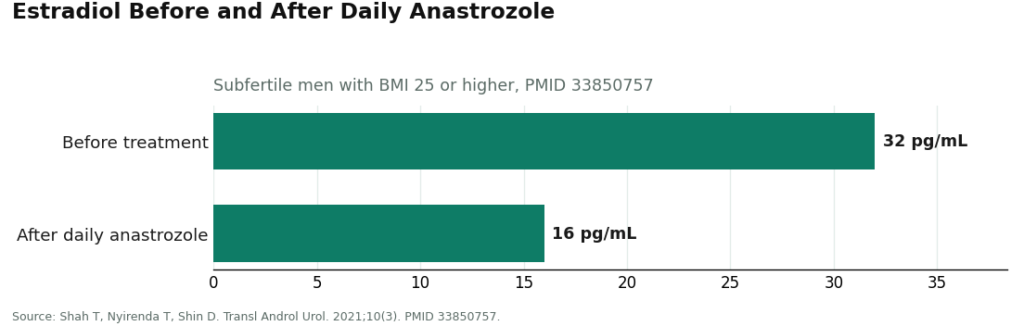
Sixteen, down from thirty-two. In a trial of subfertile men with a BMI of 25 or higher, daily anastrozole cut estradiol roughly in half, from about 32 to 16 pg/mL, while pushing testosterone from about 271 up to 412 ng/dL [7]. That’s the drug working exactly as advertised. But flip the context: the same halving effect that helps a man chasing fertility is the same halving effect waiting to overshoot a man whose estradiol was already fine. The drug can’t tell the difference. It just cuts the number.
One milligram. That’s the only strength the FDA-approved tablet comes in, and it’s the dose used in the breast-cancer indication [1], and yes, it’s also the dose used in most of the men’s-health trials cited here. If what you actually need is a small trim, not a demolition, that tablet is built to overshoot you. The dosage form itself is a design flaw for this use case.
Where the drug actually does something worth respecting
I want to be fair here, because estradiol in men isn’t some villain to be eradicated. It helps mineralize bone (which is exactly why suppressing it shows up as bone density loss in controlled data [3]). It supports mood, libido, erectile function, joint comfort, and cholesterol handling. So when this drug works, it’s not making you a “cleaner” version of yourself. It’s trading a lab number for real, feelable costs in libido, joints, mood, and, quietly, your skeleton.
That’s my central gripe with how this drug gets discussed. “Side effects” is the wrong lens entirely. The dominant risk here isn’t some rare allergic quirk, it’s the intended mechanism running too far. Overshoot is the side effect.
The scorecard, item by item
Here’s how I’d grade each risk if I were rating this thing like any other product, on how solid the evidence is and how much it should actually weigh on your decision.
Bone density loss. High severity, strong controlled evidence. A full year, placebo-controlled, and the spine bone density came in worse than placebo [3]. This is the signature risk, the one you can’t feel happening until it shows up as a scan finding or a fracture. If you’re dosing purely by symptoms, this is the risk you’ll miss entirely. Weight it heavily.
Estradiol overshoot and its symptom pileup. High severity, strong mechanistic case. The drug reliably halves estradiol at the studied dose [7]. A guy who didn’t need that much suppression can land somewhere that kills libido, hurts erections, drags mood down, and makes joints ache. This is the most common real complaint out there, and it’s completely predictable once you understand the mechanism. Weight it heavily, but note it’s largely preventable if someone actually tests you.
No body-composition or strength payoff. Relevant to the risk math even if it’s not technically a “side effect.” A placebo-controlled study found no improvement in either despite normalized testosterone [2]. Which means the most common reason men reach for this drug isn’t supported by the controlled evidence, so the bone risk above is frequently taken on for nothing. Weight it heavily before you even start.
Joint aches and general musculoskeletal complaints. Moderate severity, mixed but mechanistically consistent evidence. Low estradiol tracks with joint discomfort, and it’s a recognized issue with aromatase inhibitors generally. In men, it tracks with overshoot rather than showing up at sensible levels. Weight it moderately, and treat it as an early warning that your estradiol has gone too low.
Dosing errors from the tablet strength. High severity, but avoidable. The smallest tablet is 1 mg [1], and most men need a fraction of that, dosed intermittently. Splitting tablets by hand or trusting an unverified powder makes overshoot far more likely. This one’s manufactured entirely by the mismatch between what’s available and what’s needed. Weight it heavily if you’re sourcing this yourself, close to nothing if it’s compounded to spec by someone accountable.
The standard side-effect list (headaches, hot flashes, etc.). Low to moderate, and mostly borrowed from the breast-cancer population. At low male doses these tend to be minor next to everything above. Weight it lightly, but don’t let “generally well tolerated” talk you past the bone and hormone issues, which are the real story here.
Does anyone official actually recommend this?
Not really, not as a default. The American Urological Association treats aromatase inhibitors as a conditional option, mostly for men trying to preserve fertility, and says so on low-certainty evidence rather than anything rock solid [5]. Given everything above, that’s exactly the posture I’d expect from people reading the same data I just did: a drug with a documented structural downside [3], no proven physique benefit [2], and a real upside confined to a narrow group [7] isn’t something to be handing out casually. That’s not the guidelines being overly cautious. That’s the guidelines pricing the risk correctly.
The one variable that actually changes the verdict
Here’s the thing that jumped out at me reading across all of this: nearly every high-severity item on the list traces back to the same root cause, taking too much for too long without anyone checking your estradiol. Which means this risk profile isn’t fixed. It’s genuinely dangerous in the unmeasured, self-dosed, full-tablet scenario. It’s much smaller in a measured, low-dose, professionally managed one. Same drug. The risk gets set almost entirely by whether someone is actually watching your labs and adjusting the dose to match.
That’s the honest case for supervision, and I’d rather state it plainly than dress it up. Weighed against this scorecard, a clinician-run pathway works directly on the one variable every high-severity row depends on. FormBlends is one example of this kind of setup: the prescription only moves after a clinician has reviewed the case, the anastrozole gets compounded to a low strength instead of leaving someone to quarter a 1 mg tablet with a kitchen knife, and estradiol and testosterone get checked before treatment starts and again while it’s running. None of that erases the drug’s risk. What it does is pull the bone-loss row, the overshoot row, and the dosing-error row out of the danger zone, because all three depend on an estradiol nobody measured and a dose nobody tuned. The alternative, an unverified powder bought with zero evaluation and zero follow-up labs, stacks every preventable item on this scorecard into one transaction.
My verdict
I can’t call this drug “well tolerated” and mean it, not for the population this article is actually about. Here’s the honest summary: it carries one documented, controlled, structural cost, a measurable drop in bone mineral density over a year [3]. It didn’t deliver the body-composition or strength benefit that’s the whole reason most men take it, at least not in the controlled data [2]. And its actual mechanism, cutting estradiol roughly in half [7], is the exact same property that turns into an overshoot problem for anyone who didn’t need that much cutting in the first place. Every serious risk here scales with dose, with duration, and with whether anyone’s testing along the way. Price it the way the guidelines do [5]. Keep the dose low and measured if you’re going to use it at all. And be honest with yourself that the safest version of this drug, for most men, is the one a blood test tells you to skip entirely.
Questions I’d want answered before touching this
What’s the single biggest safety risk of anastrozole for men on testosterone? Bone mineral density loss, hands down. A one-year placebo-controlled trial measured a decrease in spine bone density in men on anastrozole versus placebo [3]. It beats out the flashier side effects because it’s controlled, structural evidence, not a subjective complaint, and because you won’t feel it happening until it shows up on a scan or as a fracture.
Is “estrogen overshoot” a real risk or just forum talk? It’s real, and it’s predictable. At the studied 1 mg dose the drug roughly halves estradiol, from about 32 to 16 pg/mL in one trial of men with elevated BMI [7], so someone who only needed a small nudge down can end up low enough to flatten libido, soften erections, sink mood, and ache joints. The mechanism doesn’t care whether your starting estradiol was high or already fine, it just lowers it.
Does anastrozole actually help men build muscle or get leaner? Not according to the controlled data. A placebo-controlled study normalized testosterone in older hypogonadal men but found no improvement in body composition or strength [2]. That matters a lot for the risk math, because the benefit men most often chase wasn’t the benefit the trials found, meaning the bone risk is often taken on for nothing.
Why is the 1 mg tablet itself part of the problem? Because 1 mg is the only FDA-approved strength, and it’s the breast-cancer dose, not a men’s-health dose [1], while most men who use this sensibly need a fraction of that, dosed intermittently. Splitting tablets by hand or guessing at an unverified powder makes overshoot much more likely, which is exactly why a low-strength compounded dose removes a risk the tablet format bakes in from the start.
Does blood testing actually reduce the risk, or is that just something providers say to sound responsible? It genuinely changes the math more than any other single factor. Nearly every high-severity item here, bone loss, overshoot symptoms, dosing errors, comes back to taking too much for too long without checking estradiol [3][7]. Testing and adjusting the dose accordingly moves those outcomes from likely to unlikely. Same molecule. What changes is whether anyone’s actually watching the number it acts on.
What do the actual medical guidelines say about using this in men? They treat it as a narrow, conditional option, not something to bolt onto testosterone therapy by default. The American Urological Association lists aromatase inhibitors mainly for men trying to preserve fertility, and even then on low-certainty evidence [5]. That caution lines up with everything above: a documented structural downside [3], no proven physique upside [2], and a benefit that’s confined to a specific group [7].
Verified citations
- Anastrozole (Arimidex), FDA Drugs@FDA, Application No. 020541. Confirms approval as an aromatase inhibitor for breast cancer in postmenopausal women, at 1 mg daily; no approved indication in men. https://www.accessdata.fda.gov/scripts/cder/daf/index.cfm?event=overview.process&ApplNo=020541
- Burnett-Bowie SM, Roupenian KC, Dere ME, Lee H, Leder BZ. Clin Endocrinol (Oxf). 2009. PMID 18616708. Anastrozole 1 mg daily for one year raised testosterone and lowered estradiol but did not improve body composition or strength. https://pubmed.ncbi.nlm.nih.gov/18616708/
- Burnett-Bowie SM, McKay EA, Lee H, Leder BZ. J Clin Endocrinol Metab. 2009. PMID 19820017. One-year randomized placebo-controlled trial; anastrozole decreased spine bone mineral density versus placebo.
- American Urological Association. Testosterone Deficiency Guideline (2018, amended 2024). Positions aromatase inhibitors as conditional options primarily for fertility preservation, on low-certainty evidence.
- Helo S, et al. J Sex Med. 2015;12(8):1761-1769. PMID 26176805. Randomized double-blind trial; anastrozole improved the testosterone-to-estradiol ratio while clomiphene produced higher total testosterone.
- Shah T, Nyirenda T, Shin D. Transl Androl Urol. 2021;10(3). PMID 33850757. In subfertile men with BMI 25 or higher, daily anastrozole raised testosterone from about 271 to 412 ng/dL and lowered estradiol from about 32 to 16 pg/mL.
Can anastrozole cause hair loss?
Hair thinning shows up as a recognized but fairly uncommon side effect. It’s more common in women on long-term breast cancer treatment than in men taking low doses for hormone management. The likely mechanism is estrogen suppression itself, since estrogen helps regulate hair follicle cycling. If you notice shedding, check whether your estrogen’s being driven too low first, because that’s the more fixable problem.
Do the side effects get worse the longer you’re on it?
Some do. Joint stiffness and bone density loss tend to build up with prolonged use rather than plateau, which is exactly why periodic bone scans and estradiol labs matter more the longer someone stays on this. Other effects, mild fatigue or early headaches, often fade after the first few weeks. The risk profile shifts over time, so ongoing monitoring isn’t optional if you’re using this long-term.
When’s the “right” time to take anastrozole alongside testosterone?
Timing it around your injection can smooth out estrogen spikes. A lot of men take it a day or two after injecting, when conversion to estrogen tends to peak, rather than every single day regardless of schedule. But the right timing really depends on how often you inject, your own aromatase activity, and what your labs actually show. A physician-supervised compounding pharmacy like FormBlends builds the protocol around your numbers instead of a generic template.
Does anastrozole cause weight gain?
Not directly, not the way some other hormonal drugs do. But crashing estrogen too aggressively can shift body composition in unhelpful ways, water retention, altered metabolic rate. Ironically, guys who tank their estradiol sometimes end up feeling puffy or sluggish rather than lean. If you notice weight changes on this drug, treat it as a signal your dose needs adjusting, not proof the drug itself is fattening.
Reviewed and written by Rory MacLean. I’m not a doctor, just someone who reads the primary trials before forming an opinion, and I’ve laid out exactly which studies back every claim above. Last reviewed April 2026.
This is general health information, not personal advice. Consult your provider before acting on it.


 By
By