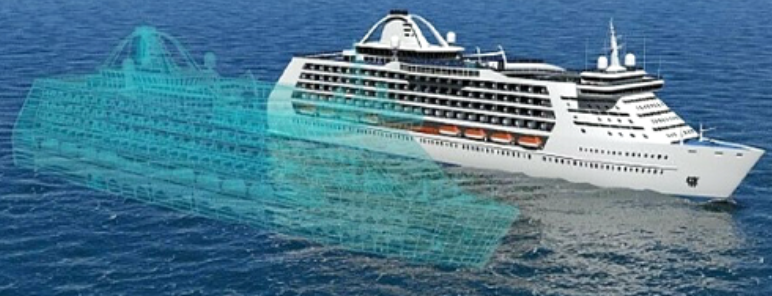
Building a vessel is expensive, and discovering a major problem after steel has been cut is even more expensive. That reality explains why simulation has moved from a specialist activity to a central part of modern marine engineering. Designers can now test performance, arrangements, loads, and operating scenarios in digital form long before the first physical component is installed. The goal is not to replace engineering judgment but to give that judgment better evidence.
From Drawings to Connected Models
Traditional drawings remain important, but three-dimensional models can reveal conflicts that are difficult to see on separate plans. Structure, piping, ventilation, cable trays, machinery, and access routes can be coordinated in a shared environment. This reduces the risk that one discipline unintentionally blocks another. It also makes it easier for owners and operators to understand spaces that would otherwise exist only as technical symbols.
Hydrodynamic Questions Can Be Tested Early
Hull behavior is one of the most obvious areas for simulation. Designers can estimate resistance, wake patterns, propulsion interaction, and seakeeping under different conditions. Computational tools allow several hull variants to be compared before model testing or detailed production design. These studies help engineers understand trade-offs rather than simply chase one performance number. A hull that offers very low resistance, for example, may need further work if motion behavior or deck immersion becomes undesirable.
Structural Analysis Targets the Right Strength
Ships face global and local loads from waves, cargo, machinery, slamming, vibration, and operational events. Finite-element analysis can show how stresses are distributed through selected structures and highlight areas that deserve reinforcement or redesign. Used properly, this supports efficient use of material because strength can be placed where it is needed rather than added broadly as a precaution.
Simulation Supports Better Ship Design Decisions
The value of digital tools becomes especially clear when many requirements interact. In ship design, changing tank location may affect stability, piping length, structural weight, and maintenance access at the same time. A connected model helps teams evaluate those consequences more quickly. Instead of waiting for late-stage reviews, designers can compare alternatives while changes are still relatively inexpensive.
Operational Scenarios Matter Too
A vessel is not used in one static condition. Cargo is loaded and discharged, fuel is consumed, weather changes, and different mission equipment may be installed. Simulation allows stability, power demand, visibility, or motion to be examined across realistic operating states. For offshore vessels, dynamic positioning loads and windage can be important. For transport vessels, loading patterns and port restrictions may dominate. The digital model becomes more useful when it reflects these real scenarios instead of only a single ideal condition.
Digital Twins Extend the Value Beyond Delivery
Some vessel models continue to provide value after construction. When connected with onboard data, a digital twin can support condition monitoring, performance comparison, maintenance planning, or retrofit studies. The model does not need to predict everything perfectly to be useful. Even a focused digital representation can help engineers compare expected behavior with actual operation and investigate why performance changes over time.
The Best Tool Is Still a Question
Advanced software can produce impressive images and detailed numbers, but accuracy depends on assumptions, boundary conditions, and data quality. Engineers still need to ask whether the model represents the real problem. Simulation works best when it is used to answer clear questions, checked against experience, and refined as better information becomes available. Its greatest advantage is not automation; it is the ability to learn earlier, when design decisions are still flexible.
A Final Practical Consideration
Simulation also improves communication between disciplines. A stability specialist, structural engineer, machinery designer, and operator may view the same change differently. Shared models create a common reference, making it easier to identify where one improvement creates a new constraint somewhere else and to resolve that trade-off before construction.
Virtual Walkthroughs Help Operators Review Arrangements
Three-dimensional models are also useful before construction because crews can review spaces virtually. Engineers may be satisfied that equipment fits, while an experienced operator notices that a valve is hard to reach or a line of sight is blocked. Virtual walkthroughs make those discussions possible without waiting for a physical mock-up. They are particularly valuable in bridges, engine rooms, control rooms, workshops, and tight service spaces where a small arrangement change can have a large effect on usability.
See also: Business Dissolution Lawyer: Understanding the Process of Closing Your Business Properly
Model Management Is as Important as Model Detail
Digital engineering creates its own discipline: models must remain controlled, traceable, and consistent. If structural, piping, electrical, and arrangement teams work from different revisions, sophisticated tools can still produce bad decisions. Clear data ownership, revision control, naming conventions, and approval workflows therefore matter. The strongest digital projects are not the ones with the most complex software; they are the ones where teams trust that the information in front of them represents the current design.

 By