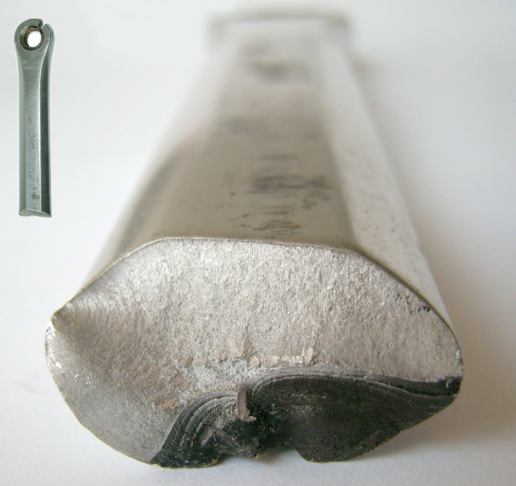
Some of the most expensive engineering failures begin with a defect too small to notice. A microscopic crack forms near a surface irregularity, a fastener hole, or the edge of a protective coating. For a while, the component continues to work normally. Then repeated loads cause the crack to grow until the remaining material can no longer carry the stress.
This pattern is why fatigue is so important in reliability engineering. It is rarely dramatic at the beginning, and it may not be detected by a simple static strength check. Understanding how and where fatigue develops gives designers a chance to address risk long before a component reaches a critical state.
Fatigue Is a Process, Not a Single Event
Fatigue damage generally develops through stages. Crack initiation comes first, often at a location with high local stress. The crack then propagates a small amount with each load cycle. Eventually, the remaining cross-section becomes too weak, and final fracture occurs. Because this progression can take a long time, a part may appear healthy during much of its service life.
Surface condition plays a major role. Scratches, machining marks, corrosion pits, and coating defects can create stress concentrations. This is why surface engineering and fatigue performance are often closely linked.
Why Coatings Can Affect Fatigue Behavior
Protective coatings are used to resist corrosion, wear, heat, and chemical attack, but they also interact mechanically with the substrate beneath them. If the coating is too brittle, poorly bonded, or unable to accommodate deformation, repeated stress may cause cracking or separation. Once that happens, the protective function can decline rapidly.
Engineers therefore look beyond coating appearance and measure how the complete coated system responds under cyclic loading. The objective is to understand whether the coating supports long-term durability or introduces a new weak point.
Failure Analysis Works Best With Controlled Evidence
When a real component fails, investigators may examine fracture surfaces, coating condition, operating history, material composition, and geometry. Laboratory reproduction can then be used to test the suspected mechanism under controlled conditions. This combination of field evidence and controlled experiments is far more useful than looking at a broken part in isolation.
In this context, Mechanical testing provides a repeatable way to reproduce loading conditions, compare specimens, and measure how damage develops. The results can show whether a failure is linked to material selection, coating behavior, processing, geometry, or an unexpected service condition.
Small Design Changes Can Produce Large Reliability Gains
Fatigue performance is often sensitive to details. A smoother transition radius, improved surface finish, different coating thickness, or revised heat treatment can significantly change the life of a component. Even the location of a hole or notch may alter where stress is concentrated.
Testing helps engineers identify which change actually improves performance. Without controlled comparison, several modifications may be introduced at once, making it difficult to know what solved the problem.
Reliability Depends on Learning From Weak Signals
The most useful reliability programs pay attention to early indicators rather than waiting for complete failure. Small cracks, coating damage, unusual wear patterns, or changes in stiffness can reveal that a design is approaching its limits. Monitoring these signals makes it possible to refine maintenance schedules and improve future product generations.
See also: Business Dissolution Lawyer: Understanding the Process of Closing Your Business Properly
A Better Understanding of Failure Leads to Better Design
The location of a crack can be as informative as the number of cycles at which failure occurs. A repeated pattern near a sharp edge may point to geometry, while damage beginning at the coating interface may suggest adhesion or surface-preparation concerns. Fractography, microscopy, and careful documentation of specimen history can help distinguish these possibilities. When multiple samples show the same initiation site, engineers have evidence that the failure is systematic rather than random. That makes corrective action more focused and can shorten the path from an observed failure to a design or process change that actually improves reliability.
Environmental exposure can make fatigue behavior even more complex. Moisture, salt, temperature swings, and chemicals may weaken a coating or accelerate damage at an existing crack. For critical applications, engineers may therefore condition specimens before cyclic loading or combine environmental exposure with mechanical evaluation. This produces a more realistic picture of how several stresses can interact during service rather than treating each factor as completely independent.
Fatigue testing is not only about proving that a part can survive a certain number of cycles. Its deeper value is that it shows how failure begins and progresses. That knowledge helps engineers design components that are more tolerant of real-world variation, easier to inspect, and less likely to experience sudden loss of function. In demanding applications, that understanding can be just as important as the headline strength of the material itself.


 By