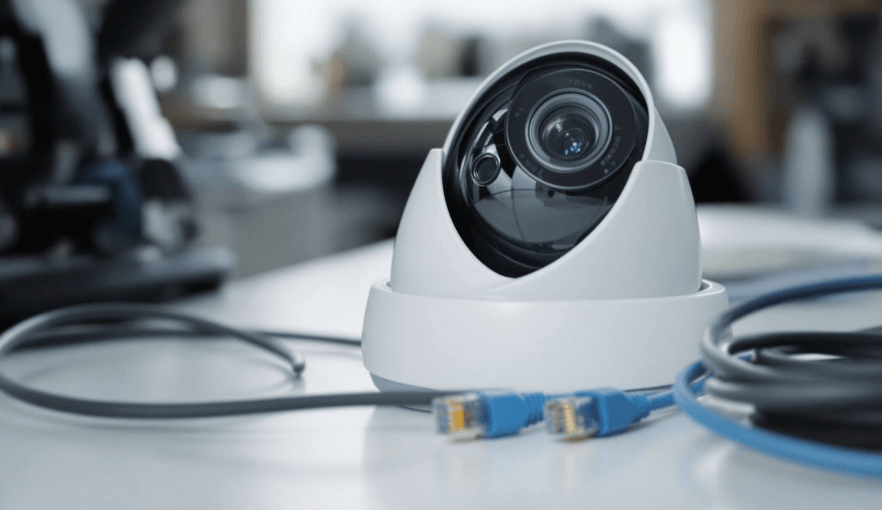
For decades, closed-circuit television meant analog cameras wired back to a recorder with coaxial cable. That technology still works, and modern analog HD cameras are far better than the fuzzy CCTV of the 1990s. But in new installations, network-based cameras have become the default. Understanding why helps you make the right call for your own building.
How the Two Technologies Differ
An analog camera sends a video signal down a coaxial cable to a digital video recorder (DVR), which converts and compresses the footage. The camera itself does very little processing.
An IP camera is effectively a small computer. It captures the image, compresses it, and sends it as data over an Ethernet network to a network video recorder (NVR) or video management software. Because the intelligence lives in the camera, IP systems can do far more at the edge, from detecting people and vehicles to counting objects or reading license plates.
Image Quality
Analog HD formats have closed much of the gap, and 4K analog cameras exist. Even so, IP cameras offer a broader range of resolutions, sensor options and specialized lenses, from compact domes to panoramic fisheye models and long-range zoom cameras. If you need to identify faces across a wide lobby or read a plate at a gate, the IP market simply offers more tools for the job.
Cabling and Power
This is where IP systems shine for new builds. Power over Ethernet (PoE) lets a single network cable carry both data and power to the camera. There is no separate power supply at each camera location and no need for an outlet on the ceiling. Standard Ethernet runs can reach up to 100 meters (328 feet), and extenders or network switches in intermediate closets push that further.
Analog systems usually need two conductors, one for video and one for power, often bundled as “Siamese” cable. The advantage of analog is that existing coax in older buildings can often be reused, which is why it remains popular in retrofits.
Scalability and Flexibility
IP cameras do not need a dedicated cable back to the recorder. They can sit anywhere on a properly segmented network, connect through switches in different parts of a building, and even link across sites. Adding a camera often means plugging it into the nearest available switch port rather than running a new home-run cable.
Smart Analytics
Modern IP security cameras commonly include on-board analytics such as human and vehicle classification, line-crossing alerts, intrusion zones and face detection. These features cut down false alarms caused by headlights, animals or moving branches, and they make searching recordings much faster. Instead of scrubbing through eight hours of footage, you can filter for “people crossing this line between midnight and 6 a.m.”
Cybersecurity Considerations
Connecting cameras to a network brings responsibilities. IP cameras should be kept on a separate VLAN from office computers, given strong unique passwords, and updated with manufacturer firmware. Remote access is best handled through the manufacturer’s secure cloud service or a VPN rather than open port forwarding. Businesses with government contracts should also check whether their equipment needs to meet NDAA procurement requirements.
Cost
Analog equipment is usually cheaper per camera, and reusing existing coax saves labor. IP systems can cost more up front, but installation savings from PoE, lower cost per added camera and longer technological lifespan often balance things out, particularly in new construction.
See also: Business Dissolution Lawyer: Understanding the Process of Closing Your Business Properly
Which Should You Choose?
- Choose IP for new construction, high-resolution needs, smart analytics, multi-site setups or systems you expect to grow.
- Choose analog HD when you have good existing coax, a tight budget and modest resolution requirements.
- Consider a hybrid recorder if you want to keep working analog cameras while gradually adding IP models.
There is no wrong answer if the system matches the building and the goals. But for most businesses planning a new installation, IP cameras offer more room to grow, better detail and features that make the footage genuinely useful.


 By

 By